
Many people arrive to me with symptoms that seem to belong to completely different medical fields:
- Dry eyes (ophthalmology)
- Tinnitus and ear pressure (ENT)
- Persistent nasal blockage or runny nose (allergy/immunology)
- Facial heaviness or sinus pain (neurology/ENT)
Different specialties.
Different explanations.
Different treatments.
these symptoms often behave as if they were simply
different exits of the same fascial line.
This article explains why — and why Fasciapuncture® is often effective when conventional approaches offer only temporary relief.
The Overlooked Control Center: The Fascial Crossroads Beneath the Jaw
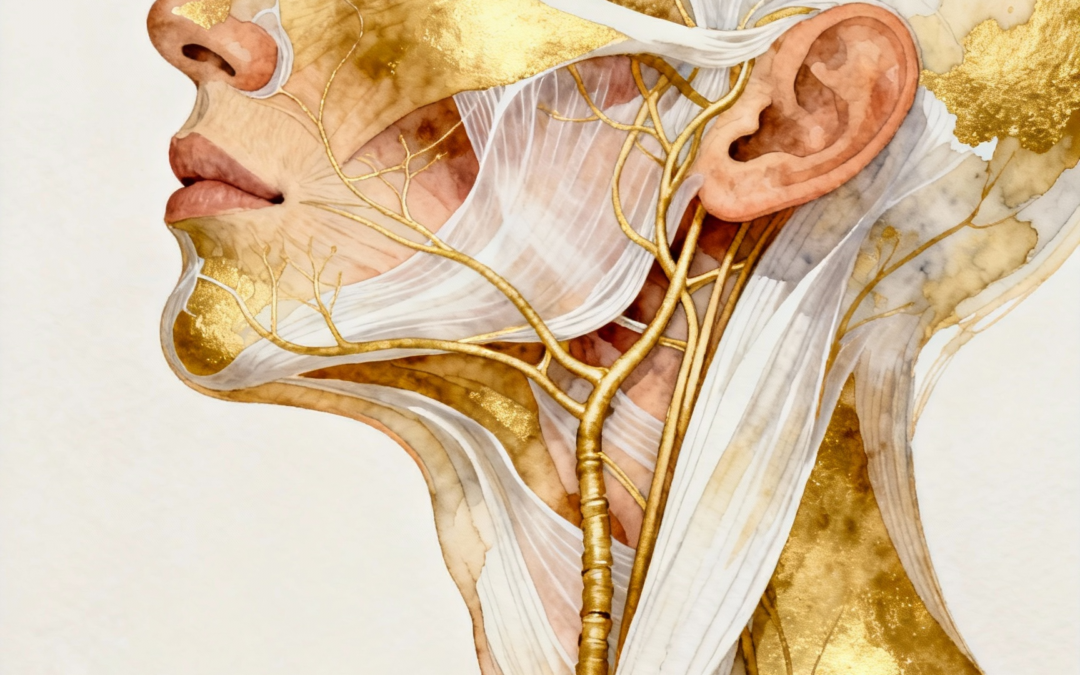
Beneath the jawline and along the upper neck lies one of the most important — but most overlooked — functional regions of the head and neck.
This fascial region is not “just soft tissue.”
It is a complex crossroads of structures that regulate:
- drainage of the head
- cranial nerve sensitivity
- autonomic balance
- pressure regulation in the eyes, ears, and nose
What Lives in This Region?
1. Submandibular Fascial Structures
Passing through or embedded in this area are:
- Parotid and submandibular glands
- Cervical lymph nodes
- Branches of the trigeminal and facial nerves
2. The Carotid Sheath
Wrapped tightly in one fascial envelope are:
- Internal jugular vein
- Carotid artery
- Vagus nerve
3. The Cervical Sympathetic Chain
This chain rests directly against the deep cervical fascia.
When the fascia tightens, the entire sympathetic system becomes overactivated.
4. The Drainage Pathways of the Head
Venous and lymphatic return from:
- the eyes
- the sinuses
- the nasal cavity
- the middle ear
All pass downward through this narrow fascial corridor.
When this region becomes tight, thickened, or elevated,
the head can no longer drain, regulate pressure, or modulate nerve sensitivity properly.
What Happens When Cervical Fascia Becomes Too Tight?
When the fascia beneath the jaw becomes chronically constricted, several predictable patterns arise.
1. Venous and Lymphatic Drainage Is Blocked
If the head’s “plumbing system” cannot drain downward:
- Eyes become dry yet irritated
- Nasal turbinates swell, leading to chronic nasal blockage
- Middle-ear pressure cannot equalize, causing ear fullness or tinnitus
- Sinuses retain fluid, creating a sense of facial heaviness
Patients often say:
“My nose is blocked but I’m not sick.”
“My eyes are dry but always tired and swollen.”
“My ear feels full even though all exams are normal.”
These are classic signs of cervical fascial congestion.
2. Nerves Become Irritated Inside a Tight Fascial Sleeve
Fascia rarely compresses nerves the way a tumor would.
Instead, it tethers and pulls — like wearing clothing that is slightly too tight.
This affects:
- Trigeminal nerve branches → eye dryness, facial pressure, sinus pain
- Facial and glossopharyngeal nerves → ear fullness, tinnitus
- Autonomic fibers → tear secretion, nasal moisture, mucosal sensitivity
Symptoms may include:
- stabbing or burning pains
- dryness with irritation
- blocked or swollen sensations
- altered hearing
These typically do not appear on MRI or CT because they are
functional, not structural disturbances.
3. Sympathetic Overactivation: Too Dry and Too Swollen at the Same Time
Chronic fascial tension overstimulates the sympathetic chain.
This creates an apparent paradox:
- Vasoconstriction leads to dryness of the eyes, nose, and throat
- Poor microcirculation promotes low-grade inflammation
- Tissue swelling produces nasal blockage, ear fullness, and head heaviness
This explains why some patients report:
- dry eyes
- and also a blocked nose
- and also ear pressure
- and also dizziness or poor sleep
It is the same functional loop repeating itself, driven by cervical fascial tension.
Clinical Cases That Reveal the Pattern
Case 1 — Severe Dry Eyes in a 70-Year-Old Woman
She had to use eye drops every 15 minutes just to tolerate the dryness.
After three Fasciapuncture® sessions releasing the cervical fascia,
her symptoms improved by around 60%.
Case 2 — Chronic Nasal Congestion in a 24-Year-Old Baker
Years of exposure to flour dust caused persistent nasal blockage.
Standard protective masks and treatments brought little relief.
After releasing fascial tension along the anterior neck,
nasal airflow improved significantly and the sense of congestion eased.
Case 3 — Sudden Right-Sided Hearing Reduction
This person presented with decreased hearing and a sense of fullness in the right ear.
On examination, the right cervical fascia was visibly elevated and markedly tense.
Following a series of fascial releases, ear fullness decreased and hearing stabilized.
Case 4 — One-Sided Nasal Blockage with Facial Pain
A 37-year-old woman experienced chronic unilateral nasal blockage
combined with facial pain on the same side.
Treatment focused on releasing submandibular and upper cervical fascial tension.
As the fascia softened, nasal airflow returned and facial pressure diminished.
How Fasciapuncture® Works
Fasciapuncture® is not merely a local technique applied to the site of symptoms.
It is a systemic intervention on the cervical fascial network —
the tight collar that surrounds nerves, vessels, and lymphatics in the neck.
Through precise micro-invasive release, Fasciapuncture®:
- restores venous and lymphatic drainage from the head
- reduces mechanical tension on cranial nerves
- calms sympathetic overactivity
- improves pressure regulation for the eyes, ears, and nose
- allows the entire head to “breathe” again
In essence, Fasciapuncture® loosens the tight fascial collar around the neck
so the entire head can function normally.
Conclusion
Dry eyes, nasal blockage, tinnitus, ear fullness, and facial heaviness may seem unrelated.
They are usually treated in different departments and framed as separate conditions.
Yet many of these symptoms share a common upstream cause:
cervical fascial tension beneath the jawline.
By addressing this overlooked fascial crossroads,
Fasciapuncture® treats the origin — not only the endpoints of pain or dryness.
When the neck fascia releases:
- the eyes soften,
- the nose opens,
- the ears clear,
- and the nervous system calms.
For patients who have tried many treatments without lasting relief,
this fascial perspective can open a new window of possibility and hope.