How It Works
A targeted, layered approach to restore fascial freedom.
Step 1: Listen to the Body — Identify the Fascial State
Your body speaks — we listen.

Before any technique or intervention, we begin by listening to how your body is currently organized.
Through precise palpation, observation, and gentle movement testing, we assess how the fascia responds — not only where tension is present, but how it is being held.
At this stage, our first question is not how to change the tissue,
but whether the system is presently available for engagement.
Not all tension reflects restriction.
Sometimes it reflects protection.
When the body is open, fascia responds, adapts, and reorganizes.
When it is not, forcing change can increase resistance rather than restore freedom.
This initial listening allows us to distinguish between these states,
so that any further step — or decision to wait — respects the body’s timing rather than imposing our own.
Transformations Through Fasciapuncture®
Real changes in posture, symmetry, and fascial tension.

Pelvic Rotation & Lumbar Tension
Lumbar fascia release eased pelvic rotation and restored balance in the lower back.
Step 2: Gentle Engagement — Support Fascial Response
When engagement is appropriate, we proceed with care.
Rather than applying force or broad correction, we work with precise, minimal input, directed to specific fascial layers that are ready to respond.
Each contact is adjusted in depth, duration, and intensity according to how the tissue reacts in real time.
We allow the fascia to reorganize through its own response, rather than pushing it toward a predefined outcome.
Change, when it occurs, is guided by feedback —
softening, warmth, ease of movement, or a shift in breathing.
If the body signals saturation, we pause.
If it signals readiness, we continue — slowly, selectively, and without accumulation.
The aim is not to do more,
but to do only what the system can integrate.
Step 3: Guided Release — When the Body Is Ready
Precise. Minimal. Respectful.
When the body signals readiness, we engage with carefully calibrated, micro-invasive input — never forceful, never cumulative.
Using ultra-thin tools, we contact specific superficial fascial layers only to the degree they can respond, allowing release to occur rather than attempting to produce it.
Often, a single well-timed point is sufficient to ease a broader pattern of tension —
not by unlocking the body, but by giving it the conditions to reorganize itself.
We continuously observe how the system responds:
changes in tone, breathing, warmth, or ease of movement.
If the tissue integrates, we proceed gently.
If it resists or saturates, we stop.
The aim is not maximum release,
but just enough input for the body to regain its own mobility and balance.
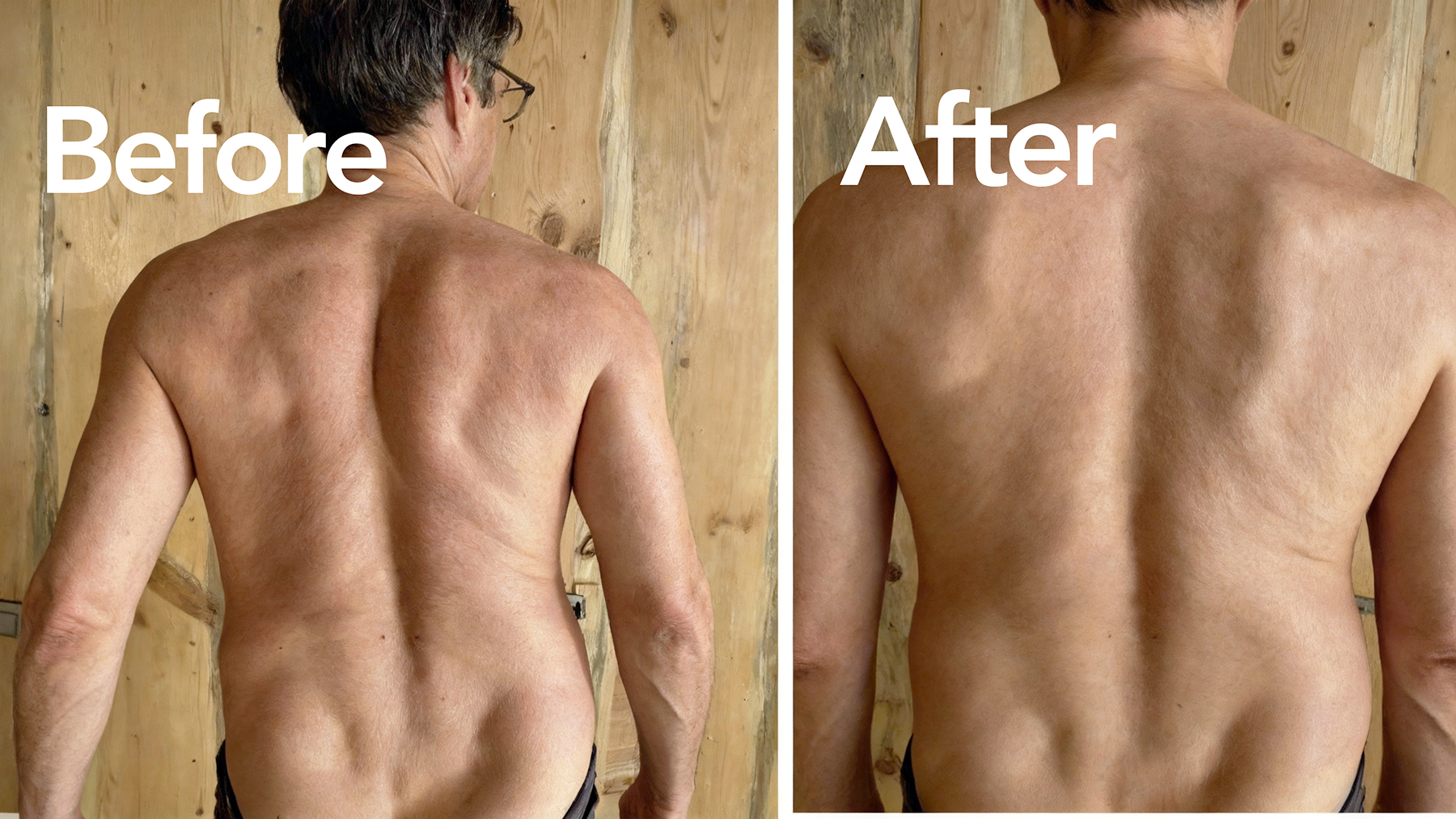
Thoracic Twist & Scapular Asymmetry
Releasing thoracic and scapular fascia reduced spinal rotation and restored upper-back symmetry.

Abdominal Fascial Tightness & Pelvic Tension
Fascial release softened chronic abdominal tension and improved pelvic-waist mobility.
Step 3: Integration — Restore Movement & Nervous Flow
When the system integrates, movement returns naturally.
As fascial layers regain their ability to glide, the nervous system gradually releases its protective tone.
Circulation improves.
Posture reorganizes.
Movement becomes less effortful, more coordinated.
Rather than forcing alignment or training a new pattern, we allow the body to settle into the changes it has already accepted.
Pain often fades not because it is chased away, but because the conditions that sustained it are no longer required.
This phase is less about doing,
and more about allowing coherence to emerge across breath, posture, and movement.
What follows is not merely relief,
but a quieter, more stable sense of internal balance —
one that the body can maintain on its own.