
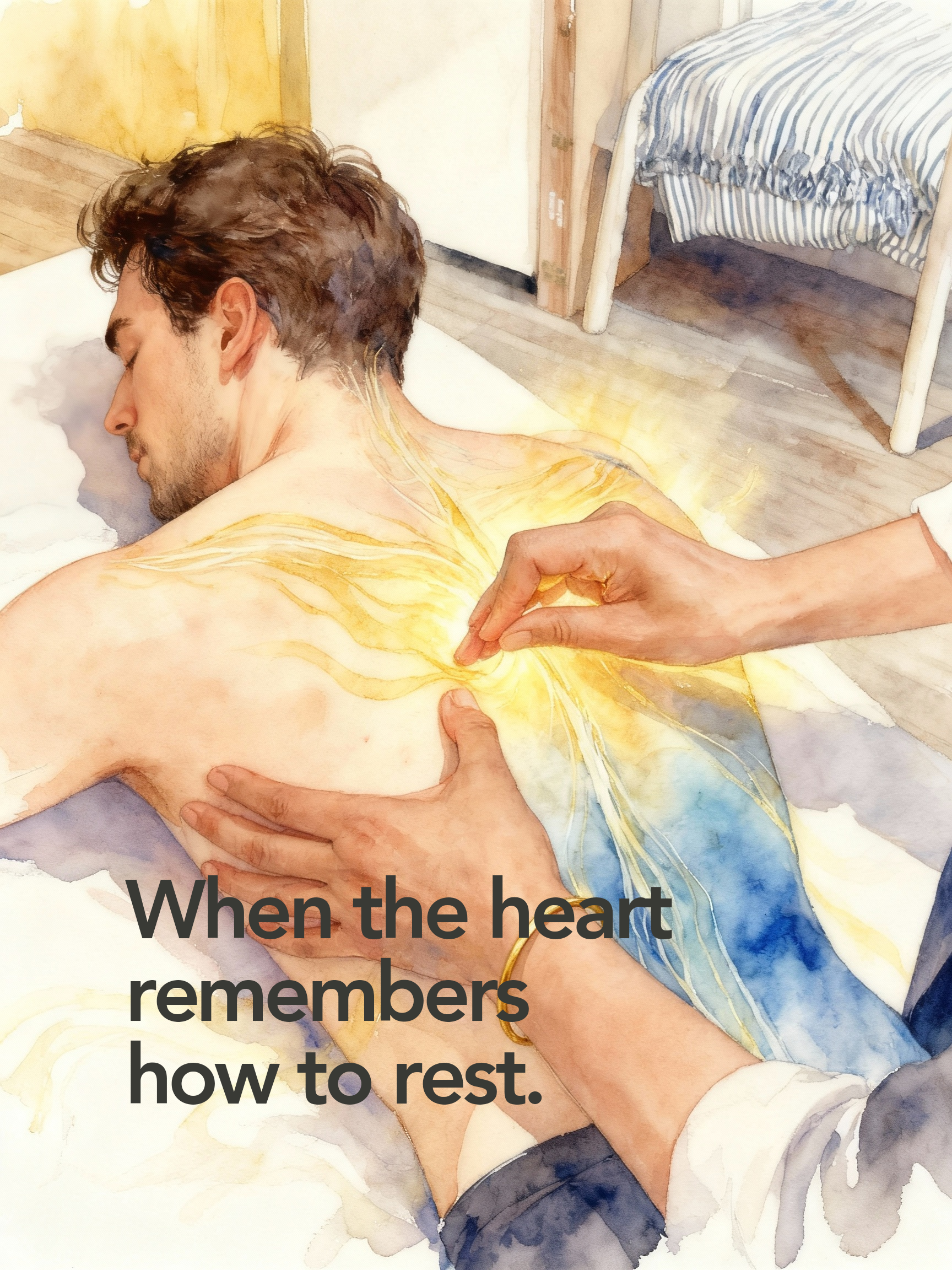
Fasciapuncture® applied along the inner scapular border
Section 1 – The Story
He was only twenty-seven — a strong, athletic nurse,
but for months, he had been living in the rhythm of fear.
Atrial fibrillation had taken over his nights.
He couldn’t rest, his pulse was chaotic,
and surgery was already on the schedule.
When he came to see me, I could sense the tension not only in his chest,
but along the inner border of his scapula — the “heart zone” of the back.
The fascia there was tight, almost armored.
With Fasciapuncture®, I released the deep myofascial tension surrounding the thoracic region.
The technique was gentle — more listening than forcing — allowing the body to remember its own coherence.
A week later, he came back smiling.
“After that first session,” he said,
“I was driving home — only fifteen minutes — and I felt so deeply relaxed that if it had been five minutes longer, I would’ve stopped the car to sleep.”“When I got home, my wife asked how I felt. I said, ‘I’ll tell you in a moment…’
Then I fell asleep on the sofa for seven straight hours.
I haven’t slept that deeply in months.”
After just one session, his arrhythmia had improved by nearly 50%.
After three sessions, it disappeared entirely.
The surgery was cancelled.
🌸 Section 2 – Clinical Reflection
Fasciapuncture® does not act directly on the heart,
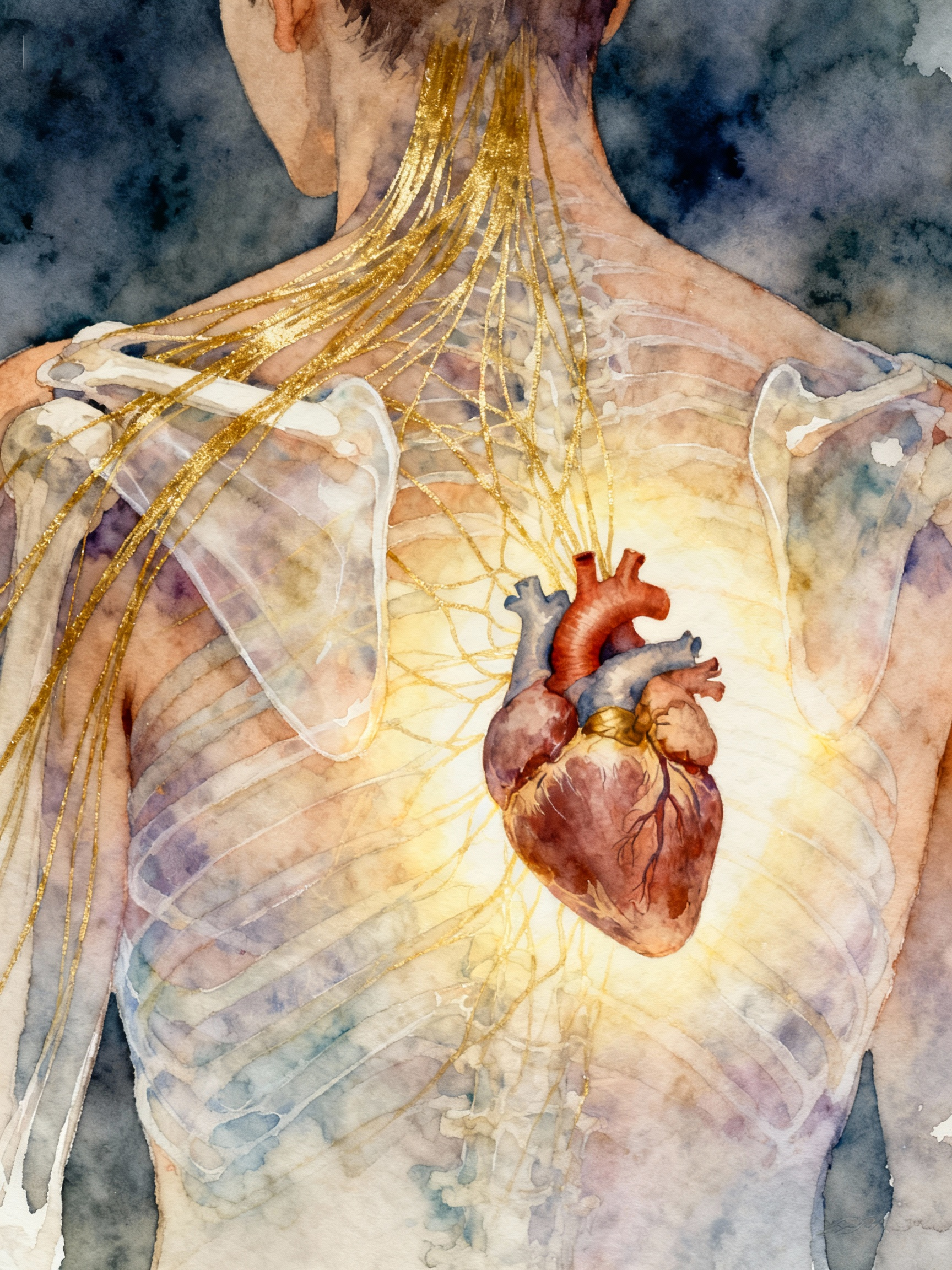
but through the release of fascial tension in the thoracic and scapular regions,
where circulatory and autonomic pathways converge.
By restoring the elasticity of these fascial planes,
blood circulation and microvascular flow improve,
allowing the cardiac rhythm to rebalance naturally.
At the same time, the relaxation of the posterior thoracic fascia eases the diaphragm,
enhances vagal tone,
and calms the nervous system.
In this sense, the therapy touches both structure and rhythm —
helping the body regain the harmony it had lost.
Key Insight
Healing sometimes begins not with intervention,
but with release —
when the body finally remembers how to rest.